Voice Reporting
Your team flags concerns every day.
Most of them disappear before anyone acts.
Forms capture what happened. Voice captures why it happened — tone, nuance, full context. Pulse gives every person on your team a way to flag a concern by voice, and turns that qualitative signal into structured data that routes, tracks, and improves your system over time.
Why concerns go unreported
The form is the problem. Not the people.
Traditional reporting tools assume people will navigate a system, find the right field, type out a description, and submit it in the middle of a busy day. They don't. Not because they don't care. Because the friction is too high. When a voice note takes under 60 seconds and requires no login, adoption changes completely.
Voice doesn't just reduce friction. It captures context that forms can't. When someone leaves a voice note, they describe the situation in their own words. That qualitative layer — tone, urgency, nuance — becomes part of the record. Your data gets richer, not just faster.
Forms take 8 to 12 minutes. Most concerns never get filed.
Email chains lose accountability. Nobody knows if it was acted on.
Verbal handoffs disappear. No record. No routing. No follow-up.
When the moment passes, the concern is gone. Sometimes the cost shows up later.
How Voice Reporting works
Three steps. Under 60 seconds. Nothing dropped.
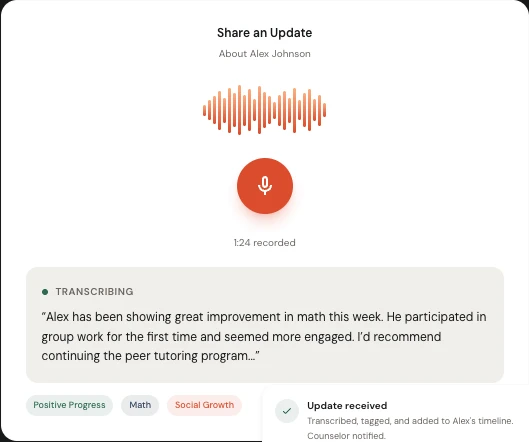
Your team records a voice note.
Anyone on your team opens Pulse and records a concern. No form. No login screen. Just tap record and speak. The whole thing takes under 60 seconds.
Every word stored. Nothing lost.
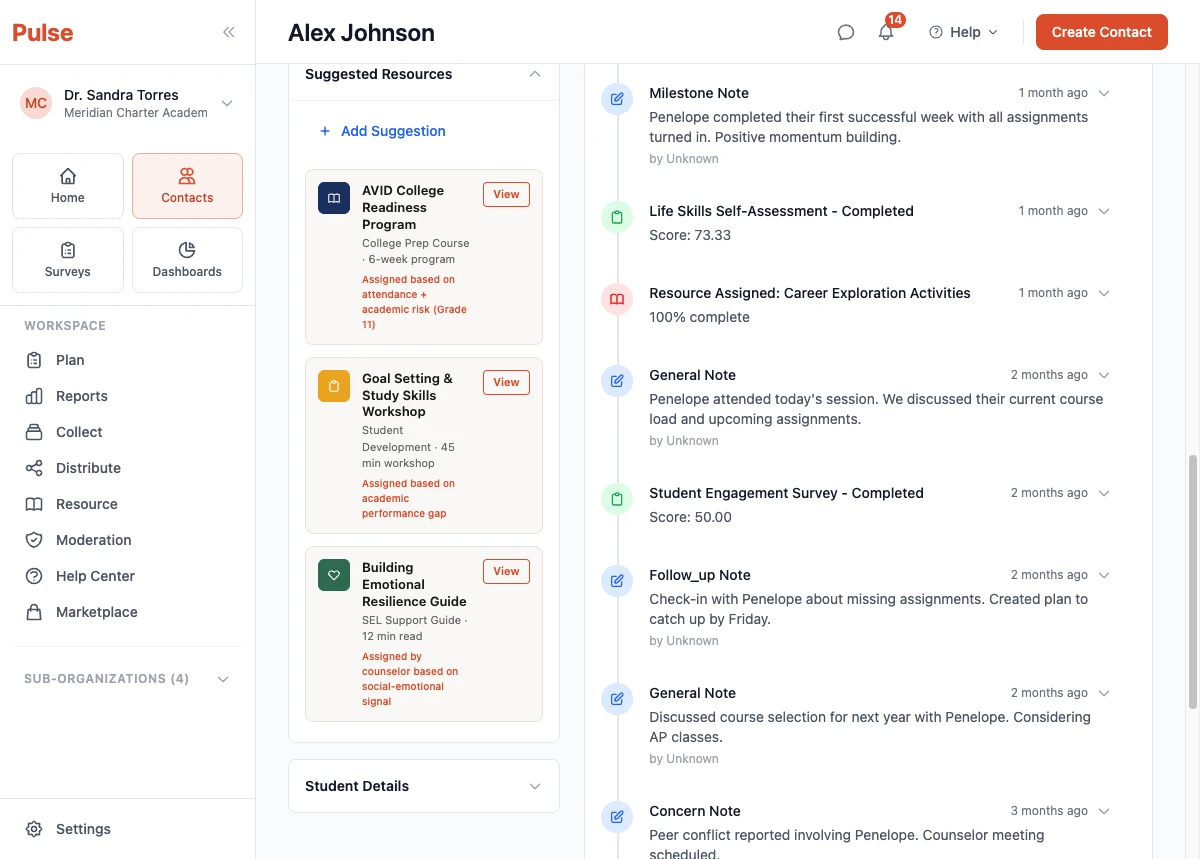
The moment someone finishes speaking, Pulse transcribes the voice note and attaches it directly to that person's record — full text, tags, and timestamp. Every word is stored. Every concern is searchable. Nothing disappears into an inbox.
The right person acts. The record builds.
The person who receives the concern sees a clear action item with full context. Every step they take is logged. The person who flagged it gets confirmation. The loop closes.
Alex Johnson
GPA
3.4
Ms. Rivera re: Alex Johnson
"Alex has been showing great improvement in math this week. He participated in group work for the first time and seemed more engaged. I'd recommend continuing the peer tutoring program."
Completed · Score: 7/10
Discussed study strategies and resources
What makes it different
Not a tip line. Not an incident system. A team tool that fits in everyone's day.
Tip lines feel like reporting on someone. Incident systems feel like filling out paperwork. Voice Reporting feels like leaving a message. It's the same gesture your team already makes when something is on their mind. Pulse just captures it, routes it, and closes the loop.
People actually use it because it requires nothing extra from them. That's why adoption is high even in organizations that have tried other reporting tools and given up.

Privacy by design
Voice memos encrypted. Access role-based. Built for organizations where data privacy is non-negotiable.
Voice memos are encrypted at rest and in transit. Only the people with explicit role-based access can hear or read a transcription. No voice data is stored longer than your organization's retention policy requires. No audio is used for training AI models.
Learn about Privacy & ComplianceEncrypted at rest
All voice recordings and transcriptions are encrypted in storage.
Role-based access
Only authorized roles can access specific recordings and transcriptions.
FERPA + privacy-first
Built for K-12 data requirements. We are actively pursuing SOC 2 Type II certification. DPA available on request.